Moratorium on Indonesian Mining Licenses
Law No. 3 of 2020 concerning amendments to Law No. 4 of 2009 (“the New Mining Law”) has majorly revised various provisions of the Mining Law.


Law No. 3 of 2020 concerning amendments to Law No. 4 of 2009 (“the New Mining Law”) has majorly revised various provisions of the Mining Law.

In the Indonesian judiciary, the Constitutional Court (Mahkamah Konstitusi) and the Supreme Court (Mahkamah Agung) are two separate judicial bodies that have different functions and powers. These courts have the authority to conduct judicial review.
The Indonesian government has issued Government Regulation (PP) Number 25 of 2020 concerning the Public Housing Savings (‘Tabungan Perumahan Rakyat/Tapera) program as an implementation of Law No 4 of 2016. This mandatory arrangement, which is mainly intended to provide housing financing for low-income participants, is a periodic deposit savings scheme used as the basis for housing financing requests.
There are many challenges in implementing the Mining Law and other regulations related to mining activities, particularly in disputes of ownership of shares in companies, overlaps of mining area, sale and purchase of mining commodities, mining service contracts, and investment failures.
The Mining Law has not yet resolved legal issues related to licensing, processing and/or refining, protection the affected community, and sanctions. Therefore, on 12 May 2020, the House of Representative (Dewan Perwakilan Rakyat “DPR”) passed the Bill of the Mining Law. As of 10th June 2020, this Mining Bill has been signed by President Joko Widodo and passed into the New Mining Law (Law no. 3 of 2020).

Multiple construction projects have been delayed or even canceled – as an impact of the pandemic. Various reasons may cause this issue, such as material and/or workforce shortages, disrupted mobilization, travel restrictions, physical distancing policy, or even suspension of all construction activities.

The ongoing outbreak of the Coronavirus Disease 2019 (“COVID-19”) has disrupted the stability of the financial system and economic growth, which particularly include the performance and capacity of the credit. As a response to this situation, the Financial Service Authority (Otoritas Jasa Keuangan “OJK”) has issued POJK 11/20, as an effort to stimulate the affected debtors, including micro-small-and medium scale enterprises (Usaha Mikro, Kecil dan Menengah ”UMKM”).

The World Health Organization on Wednesday, March 11, 2020, declared that COVID-19 is a pandemic. Business is most likely to experience the effect. If a businessman cannot perform contractual obligations as a result of the COVID-19, force majeure clauses will be very important.
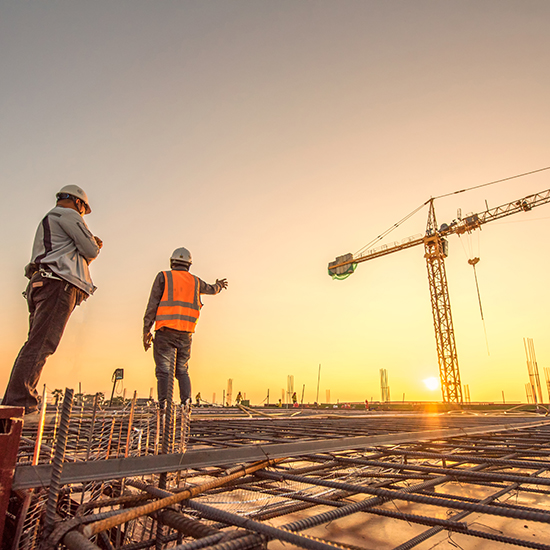
The government commits to realizing the ‘equitable construction sector’ by issuing Law No. 2 of 2017 on Construction Services (“Construction Law”) as a legal instrument that guides the implementation of construction services in Indonesia.
Under the Construction Law (Law No. 2 of 2017 on Construction Services), it is possible for foreign construction companies to operate their business in Indonesia with special requirements. There are several aspects to consider prior to establishing foreign construction companies in Indonesia.